
Contrast sensitivity across spatial frequencies
A broader view of detecting patterns at different spatial scales and contrasts.
NAYIR FOR CLINICIANS
Visual assessments, structured training and patient follow-up between visits. Start by requesting a free clinic assessment account.
FREE ASSESSMENT ACCOUNTS FOR CLINICS
Contact us to create a clinic account, set up suitable assessments and follow patient measurements during the amblyopia program.
A broader view of detecting patterns at different spatial scales and contrasts.
An independent estimate of the detectable spatial-frequency limit under test conditions; not equivalent to letter acuity.
Collect responses to a central optotype with flankers at different spacings.
Supervised clinic experimental useResponses to horizontal offsets between two lines, using physical arrow keys.
Supervised clinic experimental useA preliminary step before E-spacing to establish usable size and task comprehension. Not a replacement for BCVA.
Supervised clinic experimental useE and Vernier methods collect experimental response descriptions and require device qualification before access. They do not currently provide validated clinical thresholds or diagnoses. BCVA is supplied from the clinician’s examination.
WHY CONSIDER NAYIR TRAINING?
Primary visual cortical neurons are selective for orientation, spatial frequency and contrast. Gabor patterns let us control these properties in repeated perceptual tasks. Perceptual training uses these properties to build structured pattern-detection and discrimination tasks.
Research also implicating higher-level learning ↗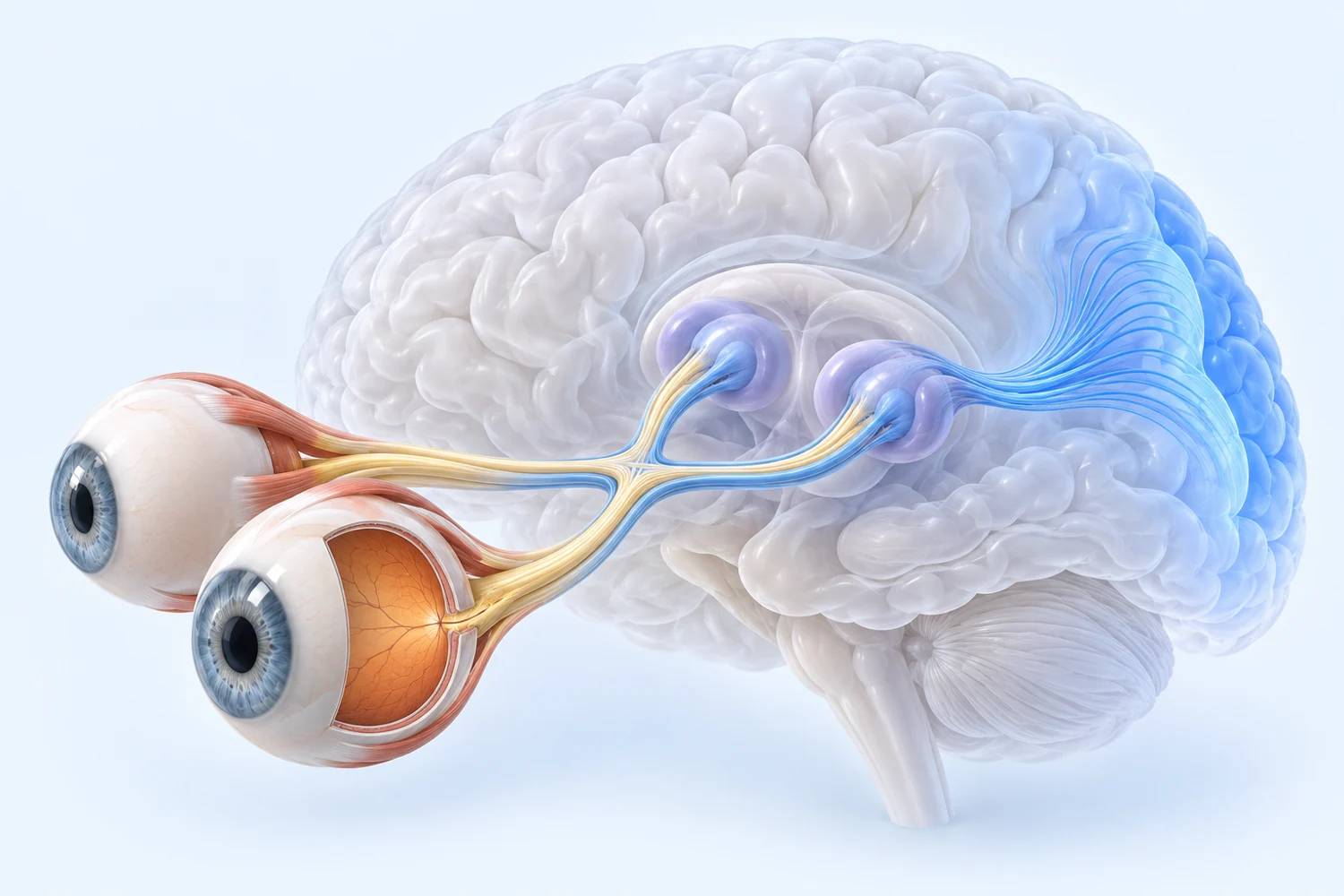
PATCHING × NAYIR
Control orientation, contrast, spatial frequency, position and visual context within defined tasks.
Patient responses guide task difficulty, adding structured practice to time spent wearing a patch.
Tasks in orientation, noise, crowding, localization, alignment and surrounding interactions.
Review completed sessions, responses and measurements, while clinical examination remains central to judging improvement.
Training uses the target eye with the other eye covered, within a plan tracked by the clinic through measurements and completed sessions.
WHAT DOES THE EVIDENCE SAY?
Published studies have investigated perceptual learning, acuity and contrast across different ages and treatment histories.
A study including ages 9–55 reported acuity and contrast-sensitivity improvements after Gabor-based perceptual learning. The findings support visual learning beyond childhood.
Read the study ↗A pilot study in children with poor patching adherence or insufficient benefit reported improvement after training.
Read the study ↗A small randomized trial in limbal-dermoid-related amblyopia compared 9 children receiving training plus patching with 8 receiving patching alone. At 6 months, adding training produced better contrast and acuity outcomes. This applies to the studied population and protocol.
Read the study ↗The studies shown concern published perceptual-learning protocols, rather than measured NAYIR outcomes. The limbal-dermoid trial found a benefit from adding training in a specific population. Chen and colleagues’ 2008 pilot found improvement with both training and patching, without a statistically significant difference in acuity improvement. Treatment selection depends on diagnosis, correction, age, adherence and measurements.
Chen et al. · 2008 ↗YOUR NEXT STEP
Request a free assessment account and discuss clinic setup and patient follow-up.
We are currently welcoming participants through the NAYIR research program.