
01
Orientation
Identify pattern orientation as discrimination difficulty changes.
THE NAYIR PROGRAM
Amblyopia is a disorder of visual development. Detail can remain difficult to resolve after correcting the glasses prescription because the difficulty involves how visual information is processed.
Explore the exercises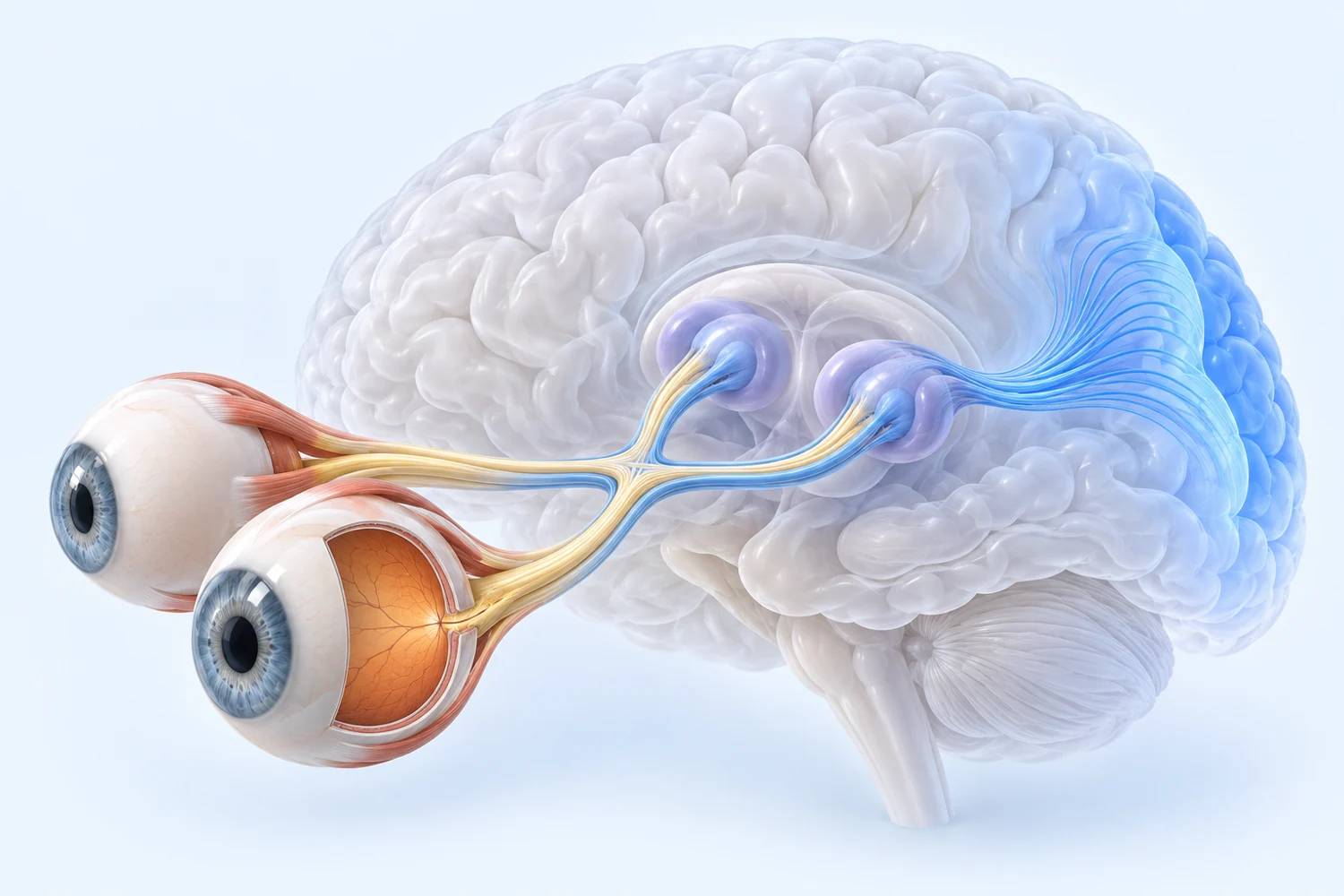
6 EXERCISES · TWO ALTERNATING DAYS
Three exercises per session, 20 active minutes each. The cycle advances after the previous session is completed.
Identify pattern orientation as discrimination difficulty changes.
Identify a target in the presence of visual noise.
Distinguish the target from neighbouring elements.
Locate the pattern relative to the fixation point.
Discriminate small differences in visual alignment.
Detect a target with neighbouring patterns arranged around it.
Train with the target eye while the other eye is covered, with short breaks throughout your session.
A BROADER VIEW OF AMBLYOPIA
Explore eight aspects of vision and the role of exercises and assessments in each.
Difficulty resolving small detail despite optimal correction.
Tasks at specified spatial frequencies; clinical acuity tracks whether learning transfers.
Needing a larger luminance difference to detect a pattern.
Detection and discrimination tasks with graded contrast.
A target becomes harder to identify among nearby elements.
Practice identifying a target with nearby flankers.
Difficulty extracting a target from competing visual information.
External-noise exercises that control the difficulty of signal discrimination.
Reduced precision when judging target position.
Localization tasks relative to fixation.
Difficulty detecting small offsets between elements.
Alignment training; Line Vernier is a separate assessment.
Surrounding patterns can alter how easily a target is detected.
Lateral training presents a target with controlled surrounding patterns.
Binocular integration and stereopsis may be affected.
Assessed by the clinician. Current training does not include binocular or direct stereopsis therapy.
THE NAYIR PROGRAM
STEP ONE
Begin with visual assessments and device setup. Record your starting point, including acuity measured by your clinician.
STEP TWO
One hour of active training a day, 4 days a week, with an initial plan of around 3 months. Allow about 72 minutes per session including breaks.
STEP THREE
Review your eye measurements with your clinician every month to see what changed and reassess the plan based on your response.
A plan built around your starting measurements and ongoing follow-up.
YOUR NEXT STEP
Tell us about yourself or your child and learn about participation and the next step.
We are currently welcoming participants through the NAYIR research program.